
 By
By 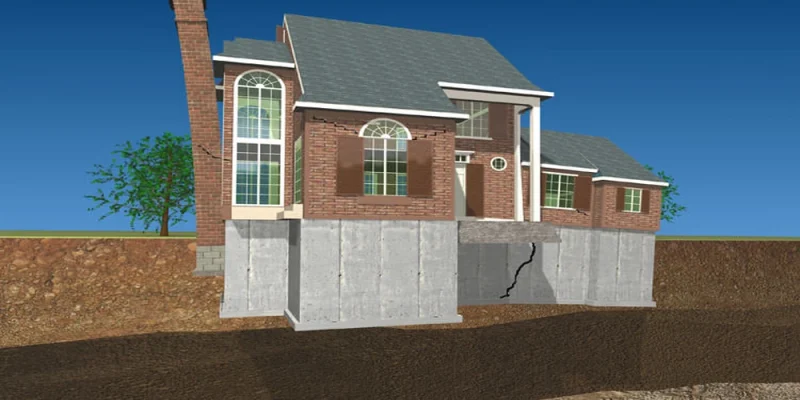
Sticking doors. Hairline cracks spreading across your drywall. A floor that seems just slightly off-level in a way you can’t quite explain. These are easy to dismiss as “old house stuff.” But if you own property on Oahu or anywhere in the Hawaiian islands, there’s a good chance something bigger is going on underneath your feet – and it’s being made worse by what’s happening above ground all around you.
Hawaii is in the middle of a genuine construction boom. That’s exciting for the economy. It is genuinely bad news for the aging foundations that sit quietly beneath thousands of residential and commercial properties across the state. Understanding why requires a short trip into the geology under your slab – and an honest look at what all that nearby construction activity actually does to the ground.
The Numbers Behind the Boom
This isn’t hype. In the fourth quarter of 2025, Hawaii’s construction sector added 2,700 jobs – a 6.9 percent increase compared to the same quarter of the prior year – and for the full year 2025, the sector added 1,600 jobs, a 4.1 percent gain over 2024, according to Hawaii’s Department of Business, Economic Development and Tourism. That pace of activity means cranes, excavators, compactors, and drilling rigs are operating across Honolulu and the outer islands at a level the state hasn’t seen in years.
Heavy machinery doesn’t just build things. It vibrates the ground. It shifts groundwater. It changes the load profile across entire neighborhoods. And for foundations that were engineered decades ago for a much quieter environment, that cumulative stress adds up fast.
The construction jobs data from Hawaii DBEDT’s Quarterly Statistical and Economic Report (2025) tells you how active the industry is right now. What it doesn’t tell you is what’s happening six feet underground as a result.
The “Stress Stack” Problem in Hawaii’s Soil
Here’s a framework worth keeping in mind. Call it the Stress Stack: every foundation is sitting at the intersection of at least three independent forces at any given time. The first is the load from the building itself. The second is the natural behavior of the soil below. The third is whatever external activity is changing the soil around it.
In most U.S. markets, that third force is relatively mild. In Hawaii during a construction boom, it’s anything but mild.
Hawaiian soil is already doing the first two things against you. The most problematic soil type across the islands is expansive clay, which absorbs moisture and swells during Hawaii’s wet season, then shrinks and pulls away from your foundation during dry spells. That cycle repeats year after year, creating a slow, grinding movement beneath your slab that most homeowners never notice until the damage is visible.
Expansive soils are characterized by high swelling potential driven by hydrophilic clay minerals, and their pronounced volume changes – swelling, shrinkage, and overconsolidation – frequently result in structural damage and substantial economic losses, according to a 2026 review in ScienceDirect. That’s a global pattern, and Hawaii sits squarely inside it.
Now add the third layer of the Stress Stack: a neighboring lot is being excavated for a new condo tower. Compactors are running two blocks over. A road crew is drilling for utilities along your street. Each of those activities transmits vibration through the soil, temporarily alters drainage patterns, and can shift the moisture balance that your foundation has spent years adjusting to. The clay that was stable at a certain moisture level is suddenly wetter or drier than it’s been in a decade. It moves. Your foundation moves with it.
The 2026 ScienceDirect study on expansive soil improvement notes that these soils remain particularly vulnerable under “cyclic wet-dry conditions” – which is exactly what external construction disturbance can trigger.
A Scenario That Plays Out More Than You’d Think
Picture a 1960s duplex in a residential Honolulu neighborhood. The original builder poured a shallow concrete slab-on-grade, which was perfectly acceptable for the soil conditions and load requirements at the time. For fifty years, the building settled gently into its site, the clay beneath it reaching a kind of uneasy equilibrium.
Then a larger apartment complex breaks ground on the adjacent parcel. Over eighteen months of construction activity, the water table around the site fluctuates. Compaction work sends vibrations through the shared soil. Drainage from the construction site alters how water pools and drains near the old duplex.
The clay wakes up. It starts to swell and shift again. The duplex owner notices a door that sticks. Then a crack appears along the interior wall where it meets the ceiling. Then the kitchen floor has a visible slope. By the time a contractor is called, the foundation has moved enough to require significant remediation. None of this would have happened without the neighboring construction trigger.
This isn’t a made-up cautionary tale. It’s a pattern that, like those at deep foundation installation experts in Hawaii see repeatedly in neighborhoods where construction activity has ramped up around older properties.
What Makes Deep Foundation Solutions Different
Shallow foundations share the problem. They’re embedded in the same clay layer that swells, shrinks, and shifts with moisture. When that layer moves, everything above it moves.
Deep foundation systems work on a different principle entirely. Helical piers and driven piles bypass the unstable surface soil altogether, transferring the structural load down to bedrock or a competent bearing layer that sits below the zone of clay movement. Once a structure is anchored that deep, seasonal soil changes at the surface no longer dictate how the building behaves.
That matters especially for properties that were built before modern geotechnical standards, which now require detailed soil investigations and specific provisions for expansive clay before a foundation design gets approved. Older buildings didn’t get that scrutiny. They got a slab, maybe some shallow piers, and a hope that the ground wouldn’t move too much. Hawaii’s current construction environment is testing that hope hard.
Five Signs Your Foundation Is Feeling the Pressure
Your building won’t send you a memo. But it will give you signals. Watch for any of these, particularly if construction activity has started or picked up near your property in the last two years:
- Doors or windows that suddenly stick after years of operating smoothly – classic sign of frame distortion from foundation movement
- Diagonal cracks at window or door corners – these follow the stress lines created when a structure racks out of square
- Horizontal cracks in exterior walls – especially concerning because they can indicate lateral soil pressure against the foundation
- Floors that feel slightly springy or slope toward one area of the room
- Gaps appearing between walls and ceilings or floors – the structure is telling you the pieces are no longer in the same place they used to be
One or two of these in isolation might be nothing. Three or more together, appearing over a short window of time, are worth a professional evaluation before you spend money painting over the cracks.
Timing Matters More Than Most Owners Realize
Foundation movement rarely stops on its own. The soil conditions that start the process don’t resolve themselves once construction nearby is finished – the clay has shifted into a new equilibrium, and the building above it has to deal with wherever it landed.
Early intervention keeps options open. A property with minor differential settlement can often be restored close to level with targeted pier installation. The same property, left another two years while the owners hope the cracks stop spreading, may need far more invasive work by the time someone finally calls an engineer.
Hawaii’s building boom is going to run for the foreseeable future. More cranes, more excavation, more ground disturbance across the islands. That’s a good thing for the overall economy – and a reason for property owners with older buildings to stop treating foundation signals as cosmetic problems and start treating them as exactly what they are: the building telling you the ground beneath it has changed.
“Settlement problems rarely resolve themselves. Accurate diagnosis and data-driven solutions are essential.”
– Geotechnical industry consensus, as summarized in professional structural engineering literature
Get a foundation evaluation before the next phase of nearby construction begins. That timing advantage is free. What comes after you’ve ignored the signals for another construction cycle usually isn’t.








Comments